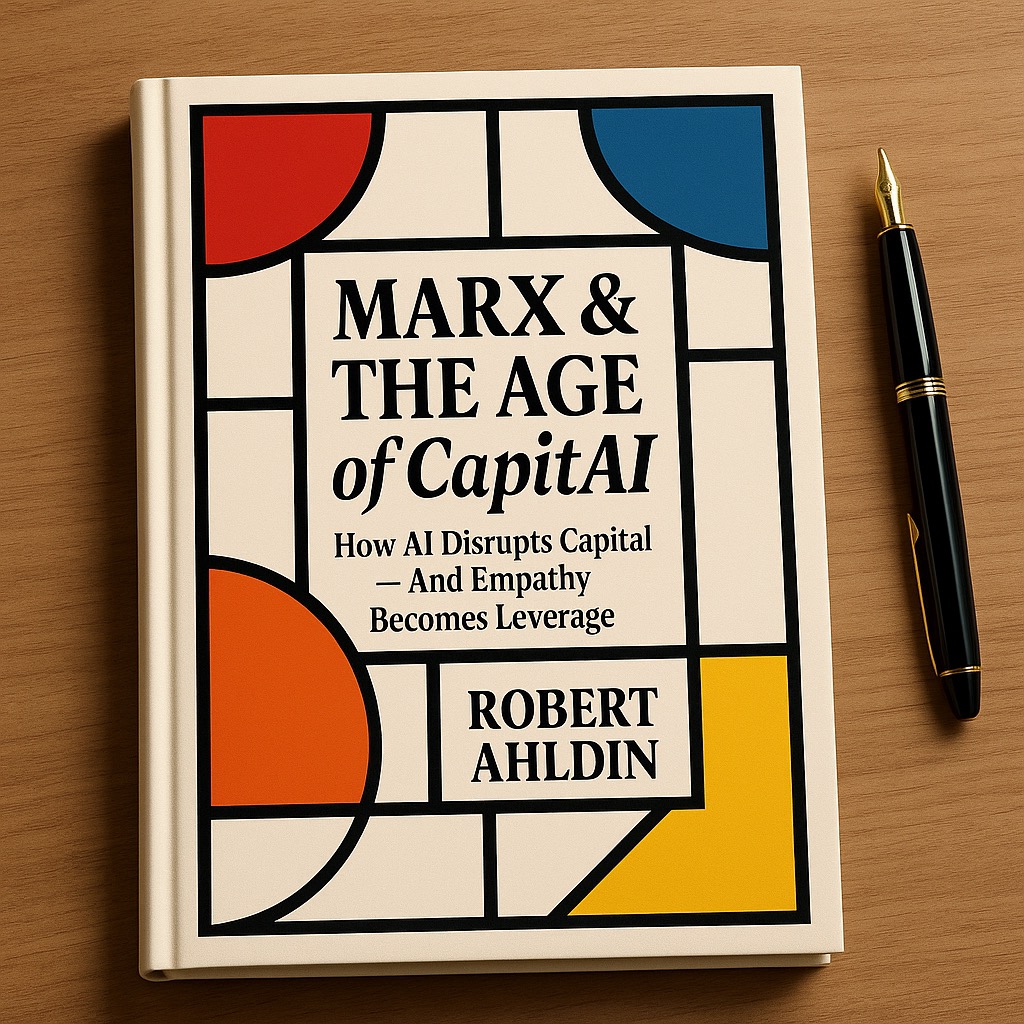
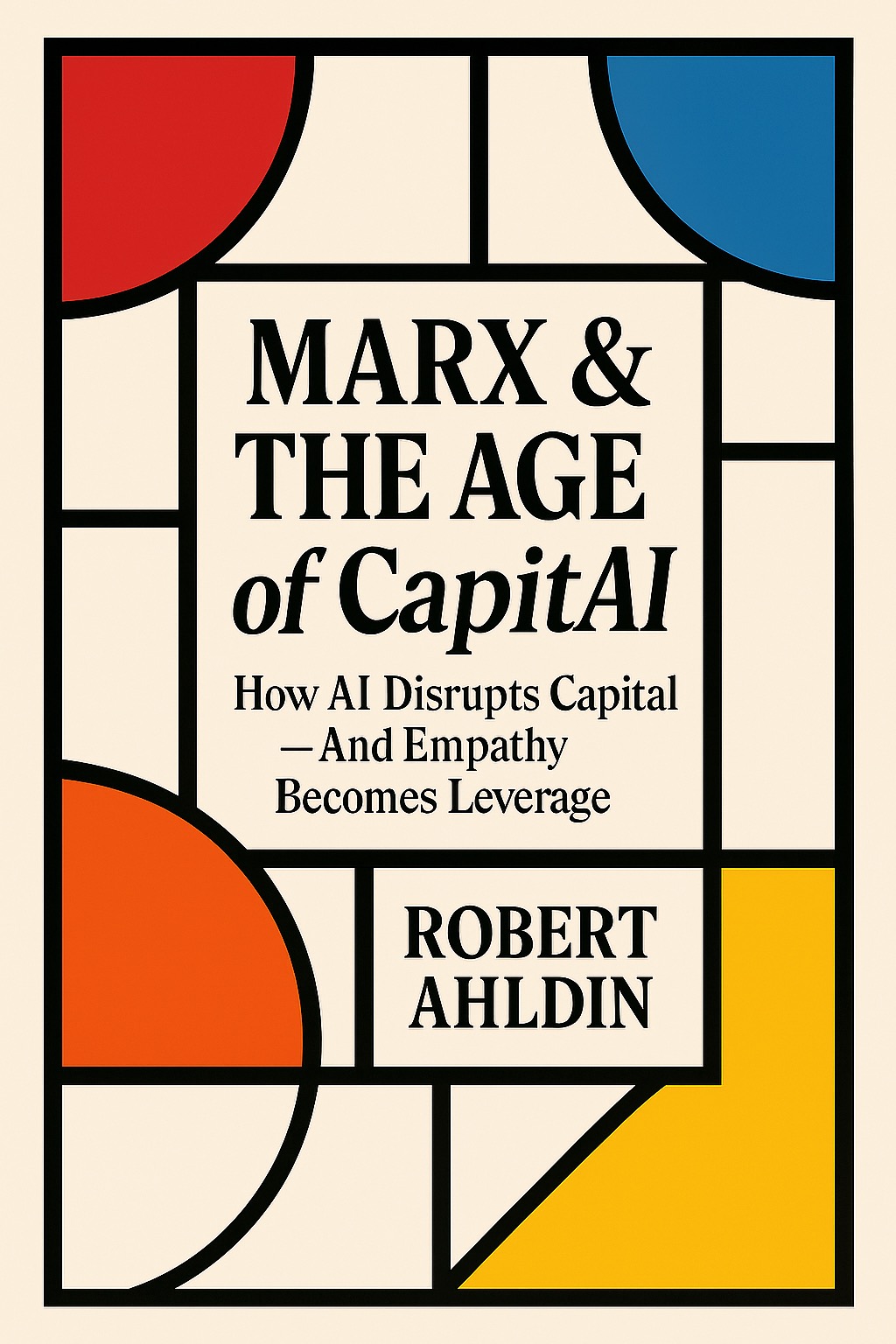
"A blueprint for understanding capitalism in the age of AI"
How AI Disrupts Capital — And Empathy Becomes Leverage.
AI is not just transforming capitalism — it's forcing a rewrite of the mental code we use to understand reality.
Marx & The Age of CapitAI exposes the clash between 19th-century ideas and 21st-century intelligence, revealing why our inherited theories can no longer explain the world we're entering.
This book doesn't teach you what to think; it upgrades how you think. If you're ready for a philosophical leap — the kind that changes what you notice, what you question, and what you believe is possible — this is the book that will take you there.
Get the book that upgrades how you think"The true value of AI isn't what it creates — it's what it removes."
"When money becomes a substitute for thought, creativity disappears."
"The new rule: too much choice narrows the mind."
"Constraints sharpen creativity."
"Ahldin delivers timeless but timely nuggets of thoughtware gold in the new era of artificial intelligence. A book for every board room."
This book is the result of a lifetime of curiosity — four decades shaped by technology, markets, entrepreneurship, and the search for patterns that explain why things work the way they do. It's not a memoir, but the ideas in it grew out of real experience: building a company with my brother, surviving crises, and learning how discipline, judgment, and people shape every outcome.
My career started in a small room in Stockholm with a VIC-20 and a stock guide. That led me into economics, psychology, computer science, equity research, and eventually to entrepreneurship and investing. Along the way, I learned that intelligence is only the starting point — what creates real results is the ability to see structure, reduce complexity, and act before others understand what's happening.
Marx & The Age of CapitAI brings together the themes that have followed me through my life: capital, intelligence, ownership, emotion, markets, creativity, power, and meaning. AI forces these ideas into a new conversation. It challenges how we think, what we value, and what we assume the future will reward.
The book is short by design — under 100 pages — because clarity matters more than volume. Every sentence is distilled. It's a framework you can return to, a lens for understanding a world where technology, economics, and human behavior are merging faster than most people realize.
If you choose to read it, thank you. And if you challenge it, even better — that's how ideas evolve.
No — it's philosophical, practical, and accessible. Curiosity is enough.
Founders, investors, creators, leaders — and anyone who wants to understand how value, capital, and creativity are changing.
Not in the narrow sense. AI is the lens — the book is about how intelligence reshapes capital, ownership, and the economy.
No. It's a framework for understanding how capitalism evolves when intelligence becomes the ultimate capital.
Because clarity matters more than volume. Every sentence is distilled — no filler.
No. It's analytical, philosophical, and grounded in markets — not ideology.
About 1–2 hours. The ideas are distilled, and the book is intentionally concise.
Because it's a great city. I've lived in the US and other countries in Europe, but chose to move back. The quality of life is fantastic. The city is beautiful, and people are friendly.
Interesting hypothesis. I haven't found the off-switch yet — but I'm still looking.
If you're open to it — yes. The book is designed to upgrade your mental code.
Because the rules of value creation are shifting faster than most people realize. Understanding the transition early is a competitive advantage.
Valuations may correct — no technology escapes Financial Darwinism. Capital flows rise, then reprice. But the underlying technology is real, transformative, and not going away.